I popped into the Central Library in Milton Keynes today (to check that I was on the Electoral Register) - and noticed an advertisement for an exhibition about the Ice Age in the MK area. It is being held in the Exhibition area (downstairs, behind the service desks - where the local studies section of the library used to be).
It was an interesting exhibition - explaining the geological research that led to the identification of the ice ages in Britain (there were a number - and the term can apply to a specific period - or to the general period which saw both warm and cold periods). There were also exhibits of animal remains from the creatures who were resident in this area. Good interpretation boards explained the different human species around.
I liked the way that local finds were highlighted (even if they weren't actually on display themselves.)
Well worth a visit - it's on until 11th May.
Showing posts with label Milton Keynes. Show all posts
Wednesday, 19 April 2017
Tuesday, 4 April 2017
The Bancroft Villa
It's nice to cycle up from our home in Furzton to Bancroft. The Redway follows the Loughton Brook, past some of the balancing lakes created to reduce flooding in that valley. Once past the concrete cows, the stream winds its way through Bancroft, with a footbridge linking to the western side - and the Roman Villa.
Fragments of Roman pottery were found by the stream fifty years ago. Major excavations took place between 1973 and 1978, directed by the Milton Keynes Archaeology Unit. Initially the site was backfilled and allowed to grass over. Then it was proposed in 1981 to create a full-size reconstruction of the villa at its most magnificent with a visitors centre and museum. Sadly these were the austerity 80s, and the ambitious plan was dropped. However further excavations were funded - covering an area of about 12,000 square metres.
The results of that excavation are set out in a two volume Monograph by R J Williams and R J Zeepat.
The earlier posts on Bronze Age and Iron Age Milton Keynes have already mentioned the settlement at Blue Bridge/Bancroft. It seems likely that the farmers there moved down the hill to the visible site of the villa. While the foundations of the main building are visible, the outbuildings lie buried underneath the open space between the roman remains and the pétanque piste to the north.
Where the Bronze and Iron Age settlement lay, a mausoleum was built. It continued in use, probably until the villa itself was abandoned in the fourth century CE (AD).
There are some excellent interpretation boards by the main villa building. The site was developed from the early years of the first century. We believe that the first farm (villa) on this site was constructed in the late first century. This was occupied until a fire destroyed mainly of the buildings in about 170 CE (AD). A large Roman style house was was built in the late third century - but there is no evidence that it was a farm. It was in the fourth century that the villa reached its full extent and glory. Clearly its inhabitants had become very prosperous.
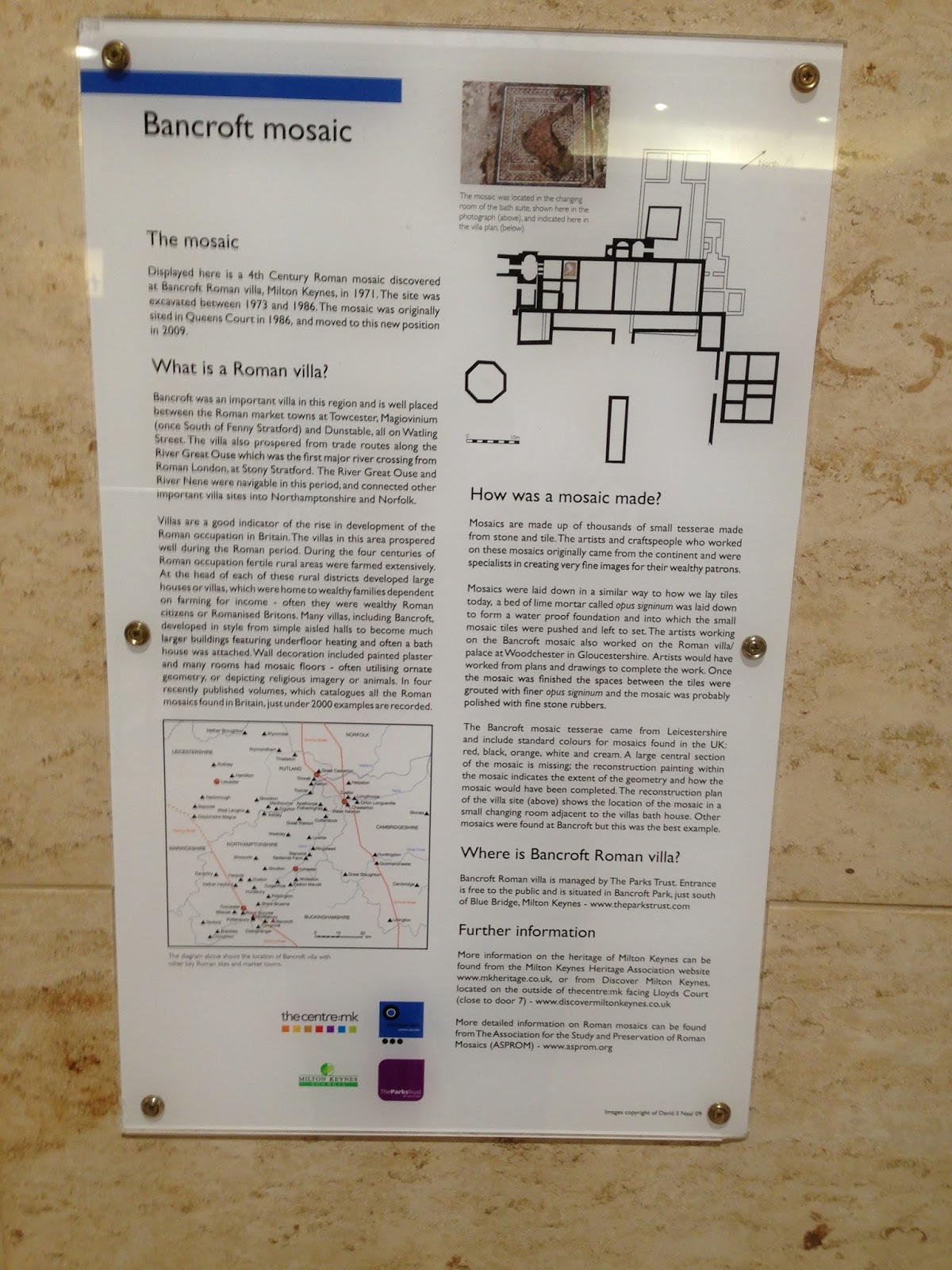
The main residential building was decorated with mosaics. One of these is currently on display in the Milton Keynes shopping area (Centre:mk) - close to the toilets in Deer Walk (Entrance North 9). In front of the villa is a fishpond - and the room layout is explained on the interpretation boards and can be seen on the ground.
Fragments of Roman pottery were found by the stream fifty years ago. Major excavations took place between 1973 and 1978, directed by the Milton Keynes Archaeology Unit. Initially the site was backfilled and allowed to grass over. Then it was proposed in 1981 to create a full-size reconstruction of the villa at its most magnificent with a visitors centre and museum. Sadly these were the austerity 80s, and the ambitious plan was dropped. However further excavations were funded - covering an area of about 12,000 square metres.
The results of that excavation are set out in a two volume Monograph by R J Williams and R J Zeepat.
The earlier posts on Bronze Age and Iron Age Milton Keynes have already mentioned the settlement at Blue Bridge/Bancroft. It seems likely that the farmers there moved down the hill to the visible site of the villa. While the foundations of the main building are visible, the outbuildings lie buried underneath the open space between the roman remains and the pétanque piste to the north.
Where the Bronze and Iron Age settlement lay, a mausoleum was built. It continued in use, probably until the villa itself was abandoned in the fourth century CE (AD).
There are some excellent interpretation boards by the main villa building. The site was developed from the early years of the first century. We believe that the first farm (villa) on this site was constructed in the late first century. This was occupied until a fire destroyed mainly of the buildings in about 170 CE (AD). A large Roman style house was was built in the late third century - but there is no evidence that it was a farm. It was in the fourth century that the villa reached its full extent and glory. Clearly its inhabitants had become very prosperous.
The main residential building was decorated with mosaics. One of these is currently on display in the Milton Keynes shopping area (Centre:mk) - close to the toilets in Deer Walk (Entrance North 9). In front of the villa is a fishpond - and the room layout is explained on the interpretation boards and can be seen on the ground.
Saturday, 4 March 2017
Milton Keynes' Bronze Age
The Bronze Age roughly covers the period 2300 BCE until 600 BCE. In reality these dividing lines are not as clear cut as we sometimes imagine. It is the introduction of metalworking in bronze (and also copper and gold) which defines this period - until iron becomes the major type of metal being worked. Another characteristic of this period was a distinctive style of burial involving decorated pottery (giving rise to the name 'beaker culture).
The evidence of Bronze Age settlement has largely come from excavation of ring ditches in the Ouse and Ouzel valleys. These are associated with burial mounds (Round barrow). The most significant finds were at Warren Farm (Wolverton Mill) - which may be the oldest; the nearby Little Pond Ground, Oakgrove and Cotton Valley (between Willen Lake North and M1 Junction 14).
There's an excellent piece about the settlement at Blue Bridge/Bancroft accessible at http://www.mkheritage.co.uk/mkm/mkarchaeology/Web%20pages/Bronze%20Age.html. The pottery is of bronze age type, but the buildings are closer to Iron Age types.
A number of Bronze Age artefacts have also been found in Stony Stratford (a socketed axe): Shenley (an urn and an arrowhead) and other sites around the city.
Near Newport Pagnell (Gayhurst Quarry) an early Bronze Age cemetery has been excavated. It had seven round barrows. At the centre of the largest barrow was a massive grave pit which showed a sequence of five successive burials from around 2000 BCE, while the six surrounding ones were 100 and 600 years later. The Illustrated History of Early Buckinghamshire says "What made this barrow remarkable was a deposit of cattle bones, perhaps the remains of 300 animals...The overall scale of the bone deposits provides as vivid an indicator of the wealth of the community that could afford to make this exceptional statement as the deposition of any number of artefacts. It illustrates the central importance of both cattle and ritual sacrifice to early Bronze Age communities"
The evidence of Bronze Age settlement has largely come from excavation of ring ditches in the Ouse and Ouzel valleys. These are associated with burial mounds (Round barrow). The most significant finds were at Warren Farm (Wolverton Mill) - which may be the oldest; the nearby Little Pond Ground, Oakgrove and Cotton Valley (between Willen Lake North and M1 Junction 14).
There's an excellent piece about the settlement at Blue Bridge/Bancroft accessible at http://www.mkheritage.co.uk/mkm/mkarchaeology/Web%20pages/Bronze%20Age.html. The pottery is of bronze age type, but the buildings are closer to Iron Age types.
A number of Bronze Age artefacts have also been found in Stony Stratford (a socketed axe): Shenley (an urn and an arrowhead) and other sites around the city.
Near Newport Pagnell (Gayhurst Quarry) an early Bronze Age cemetery has been excavated. It had seven round barrows. At the centre of the largest barrow was a massive grave pit which showed a sequence of five successive burials from around 2000 BCE, while the six surrounding ones were 100 and 600 years later. The Illustrated History of Early Buckinghamshire says "What made this barrow remarkable was a deposit of cattle bones, perhaps the remains of 300 animals...The overall scale of the bone deposits provides as vivid an indicator of the wealth of the community that could afford to make this exceptional statement as the deposition of any number of artefacts. It illustrates the central importance of both cattle and ritual sacrifice to early Bronze Age communities"
The British Museum has the "Milton Keynes Hoard", an incredible hoard of Bronze Age gold found in 2000 in a field near Monkston. It has been described as "one of the biggest concentrations of Bronze Age gold known from Great Britain". A hoard of weapons was found on what became the County Arms Hotel in New Bradwell.
Labels:
Bancroft,
Blue Bridge,
British Museum,
Bronze Age,
Cotton Valley,
Gayhurst,
Milton Keynes,
Monkston,
New Bradwell,
Newport Pagnell,
Oakgrove,
Shenley,
Stoney Stratford,
Warren Farm,
Wolverton Mill
Location:
Milton Keynes, UK
Wednesday, 1 March 2017
The Stone Age in Milton Keynes.
At school we were told about the Stone Age. (To a young mind an 'age' might seem equivalent to any other 'age' - but the Tudor Age lasted 118 years. The Stone Age around 700,000 years) - There's an excellent account of the different periods within the 'Stone Age' in "An illustrated History of Early Buckinghamshire" - edited by Michael Farley. The Palaeolithic (Old Stone Age) covers most of the period - and includes time when ice covered Milton Keynes. The Mesolithic (Middle Stone Age) covers the period 9000 to 4000 BCE, and the Neolithic (New Stone Age) can be divided into the Earlier Neolithic 4000 BCE - 3250 BCE and the Later Neolithic 3250 BCE - 2300 BCE.
We don't really know much about human activity in the Milton Keynes area during the Palaeolithic period. Several flint hand-axes have been found in gravel pits in the Bletchley area, and flint tools from around 12,000 BCE were found in a quarry at Manor Farm, Wolverton - but as R J Williams wrote - " Unfortunately there is no correlation between the distribution of palaeolithic artefacts and the faunal remains in the area, as all have resulted from chance discoveries, so it has not been possible to identify any pattern of activity for this period."
Significant quantities of Mesolithic flints have been found in the valley's of the three main rivers (see post from 21st February) - the Great Ouse, the Ouzel and Loughton Brook, with concentrations at Bancroft, Little Woolstone and what is now Caldecotte Lake. Mesolithic axes have been found a bit further away from the River Ouzel at Walton and Pennyland, which Williams suggests, " may indicate Mesolithic penetration into the woodland and perhaps the beginnings of woodland clearance on the heavier clay soils away from the river rallies."
With more settled lifestyles coming with the Neolithic age - we have greater evidence of people living permanently in the Milton Keynes areas. What is believed to be a neolithic Cursus was revealed in an extension of the quarry at Manor Farm, Wolverton.
Before the Roman villa at Bancroft was built, there was neolithic activity on Blue Bridge. At the very end of the period Stacey's Farm area (now Milton Keynes Museum) saw some farming. Other settlements have been identified at Heelands (around 2500 BC) and Secklow
We don't really know much about human activity in the Milton Keynes area during the Palaeolithic period. Several flint hand-axes have been found in gravel pits in the Bletchley area, and flint tools from around 12,000 BCE were found in a quarry at Manor Farm, Wolverton - but as R J Williams wrote - " Unfortunately there is no correlation between the distribution of palaeolithic artefacts and the faunal remains in the area, as all have resulted from chance discoveries, so it has not been possible to identify any pattern of activity for this period."
Significant quantities of Mesolithic flints have been found in the valley's of the three main rivers (see post from 21st February) - the Great Ouse, the Ouzel and Loughton Brook, with concentrations at Bancroft, Little Woolstone and what is now Caldecotte Lake. Mesolithic axes have been found a bit further away from the River Ouzel at Walton and Pennyland, which Williams suggests, " may indicate Mesolithic penetration into the woodland and perhaps the beginnings of woodland clearance on the heavier clay soils away from the river rallies."
With more settled lifestyles coming with the Neolithic age - we have greater evidence of people living permanently in the Milton Keynes areas. What is believed to be a neolithic Cursus was revealed in an extension of the quarry at Manor Farm, Wolverton.
Before the Roman villa at Bancroft was built, there was neolithic activity on Blue Bridge. At the very end of the period Stacey's Farm area (now Milton Keynes Museum) saw some farming. Other settlements have been identified at Heelands (around 2500 BC) and Secklow
Labels:
Bancroft,
Bletchley,
Blue Bridge,
Heelands,
Mesolithic,
Milton Keynes,
Milton Keynes Museum,
Neolithic,
Palaeolithic,
Pennyland,
R J Williams,
Secklow,
Walton,
Wolverton
Location:
Milton Keynes MK4, UK
Saturday, 25 February 2017
Books on Milton Keynes History
There are some excellent books to be found in Milton Keynes libraries (and not just the local studies section in the Central Library) – about the history of the city.
I’m currently borrowing (fear not, there are multiple copies) – three excellent books – which are aiding my research. I will be putting the results up on this blog.
The three books are
The Changing Landscape of Milton Keynes – R A Croft and D C Mynard.This has a chapter by R J Zeepvat on the geology and topography of this area – an essential for understanding our city’s past and present; Descriptions of the area at different periods. [Prehistoric; Roman; Saxon; Medieval and Post-Medieval]; a chapter by M Gelling on place-names of the Milton Keynes area. It concludes with a series of parish essays – focusing on discoveries made in the old parishes of our city.
Roman Milton Keynes: Excavations & Fieldwork 1971-82 – edited by Dennis C Mynard. It has some excellent maps; drawings and lists of finds. There are also a set of photographs.
Excavations on Medieval Sites in Milton Keynes – also by Dennis Mynard in the Buckinghamshire Archaeological Society Monograph Series. This too has some excellent diagrams & drawings; photographs and descriptions of the major sites.
I have my own copies of two excellent books – R J (Bob) Zeepvat’s “Roman Milton Keynes” which has chapters on Iron Age Background; The Roman Occupation; Roman Government; Towns; Communications; Countryside; Villas; Trade & Industry; Religion and Burial – and Further Reading.
and “An illustrated History of Early Buckinghamshire” edited by Michael Farley – which describes the area and puts it into a wider context.
Tuesday, 21 February 2017
Milton Keynes History
Last month the city of Milton Keynes celebrated its 50th birthday - but the area has much of historical interest. It is overlooked by the iron-age fort of Danesborough, includes the Roman settlement of Magiovinium, a Roman villa, the historic Watling Street coaching town of Stony Stratford, Bletchley Park and transport routes from across the ages (Watling Street, Grand Union Canal, Railway, M1). It includes a number of ancient villages and the historic towns of Bletchley, Stony Stratford, Wolverton and Newport Pagnell.
In this and subsequent posts, I will share something of that history. There is an excellent map called "Milton Keynes Heritage". I believe that it may still be available from the Visitor Information Centre in Centre:MK [the huge indoor shopping centre]
I've always believed that to understand the history of an area, it is necessary to study its geography. Milton Keynes is built on a low plateau, crossed by three rivers.
The biggest river forms the Northern boundary of the city itself, then crosses through some of the rural parts and through the town of Newport Pagnell. The Great Ouse runs 143 miles from its sources in Northamptonshire (near the village of Syresham), through Brackley, Buckingham, Milton Keynes, Olney, Bedford, St Neots, Huntingdon, St Ives and Kings Lynn before entering the Wash. The Treaty of Alfred and Guthrum - which settled the border between the Anglo-Saxon kingdoms and Danelaw ran along the Great Ouse between Stony Stratford and Bedford.
The second river is the Ouzel (also known elsewhere and in other eras as the Lovat). It rises not far from Whipsnade Zoo - and flows through Leighton Buzzard and through the city close to the site of Magiovinium; past the Open University, meeting the Great Ouse in Newport Pagnell.
The third 'river' is a brook - but it has carved out a pleasant valley which is partly used by the railway. Loughton Brook rises a little outside the City to its south west. It flows through the estates of Tattenhoe Park, Tattenhoe, Emerson Valley, and Furzton - where it feeds Furzton Lake, past the Milton Keynes (National) Bowl, Knowlhill (where the Teardrop lakes are), Loughton, past Bradwell Abbey and close to the Roman Villa in Bancroft, eventually meeting the Great Ouse in New Bradwell.
In this and subsequent posts, I will share something of that history. There is an excellent map called "Milton Keynes Heritage". I believe that it may still be available from the Visitor Information Centre in Centre:MK [the huge indoor shopping centre]
I've always believed that to understand the history of an area, it is necessary to study its geography. Milton Keynes is built on a low plateau, crossed by three rivers.
The biggest river forms the Northern boundary of the city itself, then crosses through some of the rural parts and through the town of Newport Pagnell. The Great Ouse runs 143 miles from its sources in Northamptonshire (near the village of Syresham), through Brackley, Buckingham, Milton Keynes, Olney, Bedford, St Neots, Huntingdon, St Ives and Kings Lynn before entering the Wash. The Treaty of Alfred and Guthrum - which settled the border between the Anglo-Saxon kingdoms and Danelaw ran along the Great Ouse between Stony Stratford and Bedford.
The second river is the Ouzel (also known elsewhere and in other eras as the Lovat). It rises not far from Whipsnade Zoo - and flows through Leighton Buzzard and through the city close to the site of Magiovinium; past the Open University, meeting the Great Ouse in Newport Pagnell.
The third 'river' is a brook - but it has carved out a pleasant valley which is partly used by the railway. Loughton Brook rises a little outside the City to its south west. It flows through the estates of Tattenhoe Park, Tattenhoe, Emerson Valley, and Furzton - where it feeds Furzton Lake, past the Milton Keynes (National) Bowl, Knowlhill (where the Teardrop lakes are), Loughton, past Bradwell Abbey and close to the Roman Villa in Bancroft, eventually meeting the Great Ouse in New Bradwell.
Labels:
Bancroft Roman Villa,
Bletchley,
Bletchley Park,
Danelaw,
Great Ouse,
Loughton Brook,
Magiovinium,
Milton Keynes,
Milton Keynes Visitor Information Centre,
Newport Pagnell,
Ouzel,
Stony Stratford,
Wolverton
Location:
Milton Keynes MK4, UK
Monday, 23 January 2017
Milton Keynes 50 today!
Happy Birthday to a great city. Created 50 years ago today by ministerial order, the city has transformed this area of North Buckinghamshire. It now has a population of over a quarter of a million citizens. We moved here in 2009 - and wouldn't want to live anywhere else. We live close to Furzton Lake - a carefully planned artificial balancing lake - which is now home to a variety of birds. I love being able to walk from my home to Milton Keynes Central station through two miles of parkland. (Despite its image as a concrete city, it has millions of trees and a redway grid offering a healthy alternative to its road & roundabouts grid)
It also has a fascinating history. One of the advantages of a planned development in the 1960s onwards - is that archaeologists went in before building began. Roman villas (& a fine mosaic now on permanent display in the shopping centre); bronze and Iron Age settlements & a number of treasure hoards have been found. I live half a kilometre from Watling Street, a hundred metres from an Iron Age settlement and a few doors down from where a gold Roman brooch was discovered. Bletchley Park is a 25 minute walk away - and Alan Turing stayed in a then-pub in the estate neighbouring ours.
In this blog I will be writing about that history - there are already a number of such posts (do take a look) - but I'm working my way through the many archaeological reports that have been published - and other histories that have been published.
And if you haven't visited MK - it's worth a visit. Explore The redways (The red coloured paths wide enough for cyclists and pedestrians to peacefully co-exist - that go through the countryside in the city). Visit Bletchley Park, or our Roman villa in Bancroft. Walk through Stony Stratford past the building in which Richard III took his nephew into "protective custody", or Newport Pagnell - a key to the English Civil War of the 1640s (or Shenley Toot - or the ruins of Wolverton Castle - both built during the civil war after King Stephen seized the throne)
It also has a fascinating history. One of the advantages of a planned development in the 1960s onwards - is that archaeologists went in before building began. Roman villas (& a fine mosaic now on permanent display in the shopping centre); bronze and Iron Age settlements & a number of treasure hoards have been found. I live half a kilometre from Watling Street, a hundred metres from an Iron Age settlement and a few doors down from where a gold Roman brooch was discovered. Bletchley Park is a 25 minute walk away - and Alan Turing stayed in a then-pub in the estate neighbouring ours.
In this blog I will be writing about that history - there are already a number of such posts (do take a look) - but I'm working my way through the many archaeological reports that have been published - and other histories that have been published.
And if you haven't visited MK - it's worth a visit. Explore The redways (The red coloured paths wide enough for cyclists and pedestrians to peacefully co-exist - that go through the countryside in the city). Visit Bletchley Park, or our Roman villa in Bancroft. Walk through Stony Stratford past the building in which Richard III took his nephew into "protective custody", or Newport Pagnell - a key to the English Civil War of the 1640s (or Shenley Toot - or the ruins of Wolverton Castle - both built during the civil war after King Stephen seized the throne)
Wednesday, 28 December 2016
2016 An "Important" Year?
History Blogs of the future will no doubt make many references to a remarkable (if troubling year). It saw events which felt like massive earthquakes - the British Referendum, which led to a win for the forces seeking withdrawal from the European Union. In November, the shock winner was Donald Trump. Both the UK and US seem destined to be one-party states, at least until the next elections and perhaps for longer. Referenda brought down two European Prime Ministers, and a French President declined to seek a second term.


As this year comes to an end, the questions we need to be asking, are whether these were shooting stars - which may give rise to comments in future history Blogs - or whether they are signs of a seismic shift in world affairs.
But for this history blog, it is too early to be rushing to conclusions. (You might want to visit two of my other blogs - Washminster and jdm_progressive - for tentative conclusions and analysis.
This blog looks further back. During 2016 I had the opportunity to visit some very interesting places, take photographs, and research some of the history associated with them. In 2017 it is my aim to post about these visits and that research. I'm also intending to make further visits. During my pre-Christmas holiday in Rutland, I reviewed Milton Keynes history (which despite its 50th anniversary history in 2017, has a history going back to the Stone Age). I've also been reading up, amongst other things, about Alfred the Great, William the Conqueror and Shakespeare.
I hope you will become a frequent visitor to this blog in 2017. For now, I wish you a happy and prosperous New Year.


As this year comes to an end, the questions we need to be asking, are whether these were shooting stars - which may give rise to comments in future history Blogs - or whether they are signs of a seismic shift in world affairs.
But for this history blog, it is too early to be rushing to conclusions. (You might want to visit two of my other blogs - Washminster and jdm_progressive - for tentative conclusions and analysis.
This blog looks further back. During 2016 I had the opportunity to visit some very interesting places, take photographs, and research some of the history associated with them. In 2017 it is my aim to post about these visits and that research. I'm also intending to make further visits. During my pre-Christmas holiday in Rutland, I reviewed Milton Keynes history (which despite its 50th anniversary history in 2017, has a history going back to the Stone Age). I've also been reading up, amongst other things, about Alfred the Great, William the Conqueror and Shakespeare.
I hope you will become a frequent visitor to this blog in 2017. For now, I wish you a happy and prosperous New Year.
Labels:
2016,
Brexit,
Donald trump,
jdm_progressive,
Milton Keynes,
Washminster
Location:
Milton Keynes, UK
Tuesday, 26 April 2016
Welcome to JDM's History Explorer
This week I am relaunching four of my blogs (strictly speaking three - a new one joins the family tomorrow). If you are a former reader of JDM's History Explorer - welcome back. If this is your first visit - a very warm welcome.
History has always interested me. As a child living in the English West Midlands, two of the delights of visiting my grandparents in South Wales were to stop at Raglan Castle on the way down, and Carreg Cennen Castle when we arrived. Local history always attracted - so I read a lot about the places I have lived in: Aldridge; Sheffield; Northampton; Rugby and now Milton Keynes.
A few weeks after we arrived in Britain's newest city, an American friend visited - and told me that while they were thrilled that we clearly enjoyed the delights of MK, for an American it was a disappointment. Old English towns and cities were great, but "Milton Keynes has no history". It was like a red rag to a bull - and in the last seven years I've spent a lot of my spare time finding out about the history of the area covered by MK. One of the advantages of a new-build city is that the archaeologists went in first - and excavated the areas before the builders moved in. As a result there is a wealth of information about the city's ancient past. I live only yards from an iron age settlement - and the Roman Watling Street runs at the eastern end of Furzton, the estate in which I live.
In my spare time, I love to visit historic sites - last week I visited both Waddesdon Manor (near Aylesbury) and the Tower of London. Reading about people, places and events in history is a delight for me.
JDM's History Explorer will share that with you. I will regularly include hyperlinks to web sites about the topics being discussed (just click on the highlighted words). I have also been building up a library of photos and information. My aim is to entertain and inform you.
Do send your comments and suggestions to jdavidmorgan@googlemail.com
History has always interested me. As a child living in the English West Midlands, two of the delights of visiting my grandparents in South Wales were to stop at Raglan Castle on the way down, and Carreg Cennen Castle when we arrived. Local history always attracted - so I read a lot about the places I have lived in: Aldridge; Sheffield; Northampton; Rugby and now Milton Keynes.
A few weeks after we arrived in Britain's newest city, an American friend visited - and told me that while they were thrilled that we clearly enjoyed the delights of MK, for an American it was a disappointment. Old English towns and cities were great, but "Milton Keynes has no history". It was like a red rag to a bull - and in the last seven years I've spent a lot of my spare time finding out about the history of the area covered by MK. One of the advantages of a new-build city is that the archaeologists went in first - and excavated the areas before the builders moved in. As a result there is a wealth of information about the city's ancient past. I live only yards from an iron age settlement - and the Roman Watling Street runs at the eastern end of Furzton, the estate in which I live.
In my spare time, I love to visit historic sites - last week I visited both Waddesdon Manor (near Aylesbury) and the Tower of London. Reading about people, places and events in history is a delight for me.
JDM's History Explorer will share that with you. I will regularly include hyperlinks to web sites about the topics being discussed (just click on the highlighted words). I have also been building up a library of photos and information. My aim is to entertain and inform you.
Do send your comments and suggestions to jdavidmorgan@googlemail.com
Sunday, 1 November 2015
New Years Day
The Celts apparently celebrated 1st November as the start of their year. One website I found states:-
“November 1 is the Celtic feast of Samhain. Samhain, Gaelic for “summer’s end,” was the most important of the ancient Celtic feasts.
The Celts honored the opposing balance of intertwining forces of existence: darkness and light, night and day, cold and heat, death and life. The Celtic year was divided into two seasons: the light and the dark, celebrating the light at Beltane on May 1st and the dark at Samhain on November 1st.
Therefore, the Feast of Samhain marks one of the two great doorways of the Celtic year. Some believe that Samhain was the more important festival, since it marked the beginning of a new dark-light cycle. The Celts observed time as proceeding from darkness to light because they understood that in dark silence comes whisperings of new beginnings, the stirring of the seed below the ground. Therefore, the Celtic year began with the season of An Geamhradh, the dark Celtic winter, and ended with Am Foghar, the Celtic harvest.”
If this was the case, then there would have been plenty of celebrations in the so-called "New City" of Milton Keynes on this day a couple of thousand years ago. When our new city was being built, archaeologists were given a great opportunity to discover our ancient history. There were a number of iron age sites – including a settlement in the centre of Furzton (where I live); and close to the site of the Roman Villa in Bancroft.
The map below (from Croft and Mycroft’s excellent “The Changing Landscape of Milton Keynes” [copies available for loan from the libraries at Bletchley; Stony Stratford; Wolverton; and Woburn Sands – and at the MK Local Studies Library in the Central Library]) show the main sites. You may be able to enlarge the picture by clicking on it.
“November 1 is the Celtic feast of Samhain. Samhain, Gaelic for “summer’s end,” was the most important of the ancient Celtic feasts.
The Celts honored the opposing balance of intertwining forces of existence: darkness and light, night and day, cold and heat, death and life. The Celtic year was divided into two seasons: the light and the dark, celebrating the light at Beltane on May 1st and the dark at Samhain on November 1st.
Therefore, the Feast of Samhain marks one of the two great doorways of the Celtic year. Some believe that Samhain was the more important festival, since it marked the beginning of a new dark-light cycle. The Celts observed time as proceeding from darkness to light because they understood that in dark silence comes whisperings of new beginnings, the stirring of the seed below the ground. Therefore, the Celtic year began with the season of An Geamhradh, the dark Celtic winter, and ended with Am Foghar, the Celtic harvest.”
If this was the case, then there would have been plenty of celebrations in the so-called "New City" of Milton Keynes on this day a couple of thousand years ago. When our new city was being built, archaeologists were given a great opportunity to discover our ancient history. There were a number of iron age sites – including a settlement in the centre of Furzton (where I live); and close to the site of the Roman Villa in Bancroft.
The map below (from Croft and Mycroft’s excellent “The Changing Landscape of Milton Keynes” [copies available for loan from the libraries at Bletchley; Stony Stratford; Wolverton; and Woburn Sands – and at the MK Local Studies Library in the Central Library]) show the main sites. You may be able to enlarge the picture by clicking on it.
Location:
Milton Keynes, UK
Monday, 27 July 2015
My home
I live on the very modern estate of Furzton in Milton Keynes. Much of it was build in the 1980s and 1990s. The lake (which is superb for bird watching; or walking) was built to ensure that flooding down the Loughton Brook was avoided. But, as I've mentioned in earlier posts, it has a heritage going back before the Romans arrived. I live only yards from an iron age settlement - and the major Roman Road we now refer to as Watling Street is the Eastern boundary.
The map below (which if clicked expands), is a hand drawn map of the Furzton area from the 16th Century. In the top left hand corner is the small village of Shenley Brook End. The three streams which flow into today’s Furzton Lake can be seen. The most northerly is the stream which flows through Shenley Brook End, which now flows into the Lake near the car park in Shirwell Crescent. The second, which has the name “Chaldwell” under it – now runs through the northern part of Emerson Valley, meeting the lake at its most westerly point. The third now divides North Furzton from South Furzton. Alford bridge is where Watling Street crossed the main stream. It may be the same Hertford Bridge that Sir Frank Markham writes about as the scene of a robbery in June 1766 that led to the rector of Tingewicke pursuing and fatally shooting the highwayman. He was acquitted of manslaughter.
Thursday, 23 July 2015
Did the Romans march from Westminster to Milton Keynes?
As noted in the last post, Watling Street ran from the channel ports to Londinium and up through Milton Keynes to Wroxeter and Chester. But was this the original route?
Londinium was, like Milton Keynes, a new city (although they both had their roots thousands of years beforehand). By 50AD, according to a notice in the Museum of London, the original road was diverted to take in this developing new city. Where did the original route run?
One of the characteristics of Roman roads was that they are remarkably straight. Unlike the later roads which can be notoriously windy, Roman roads joined up points in a straight line. There are of course abrupt changes of direction to avoid some obstacles.
If the road from Dover were continue in a north westerly direction; and the Edgware Road was to follow its path south easterly (rather than abruptly turning eastwards into Oxford Street) they would end up facing each other across the Thames at Westminster.
There has been an oral tradition that the Thames could be crossed by foot at certain times where the Palace of Westminster now stands. Archaeological work (see The royal palace, abbey and town of Westminster on Thorney Island – Museum of London Archaeology Service, 2006) suggests that a sandbank once extended beneath the Palace of Westminster into the then wider & shallower Thames, just to the south of St Stephen’s Chapel (the ‘original’ House of Commons) close to the statue of Richard the Lionheart.
If this thesis is correct we had a direct link to Westminster – via Dunstable; St Albans; the Edgware Road – across Park Lane towards the entrance to Buckingham Palace (the site of Cowford – where the road crossed a branch of the River Tyburn is near to the Victoria Memorial) – across to Tothill Street and along the “ridge” on Thorney Island where Westminster Abbey now stands.
Wednesday, 1 July 2015
Welcome...
Today "JDM's History Explorer" launches. This will be a blog dedicated to history. I've always loved history - and continue to enjoy discovering more about past events and personalities. Over recent months - as a hobby - I've been reading about - and visiting some fine historical sites. This blog will record what I've already found out - and what I will discover in the future.
This blog will not be limited to any particular place or period. It will reflect where I've been; and what I've read. So who am I? and what attracts me?
Firstly, I am not a professional historian. History has however played an important role in my academic life. For many years I have taught, at Universities such as Leicester, Warwick, Northampton, Wolverhampton and the Open University - in two disciplines - Law and Political Science. It is impossible to explain today's law and politics without reference to history. Parliament; the US Congress; Land Law; Constitutional Law - does not make sense, except as the result of events in history. I have also worked at the UK Parliament - and my favourite activity is taking groups around "the Palace" - so many of the current customs in Parliament owe their existence to "accidents of history" This blog will explore some of them.
I live in Milton Keynes - a "New City", first planned in the 1960s. Some people think we have no history here. In fact a friend told me that within a few weeks of moving here. It was like a red rag to a bull - in the last six years I have been devouring archaeological reports, and visiting some of that "non-existent" history - from the Roman Villa in Bancroft, to Bletchley Park (via an iron age settlement yards from (and a few feet below) my home. All this will be explored in the Blog.
I'm also a "history tourist" - and have taken the opportunity to get around England to visit; learn about, and take pictures of some of this country's wealth of history.
Those who know me well - are aware of my love of both France and the USA - and those two countries (and particularly Washington DC; the American civil war battlefields; Paris; the Loire Valley; Brittany and Normandy) will also feature in future posts.
On Friday, I will be posting about a place I usually pass through at great speed while making my way down to Westminster.
This blog will not be limited to any particular place or period. It will reflect where I've been; and what I've read. So who am I? and what attracts me?
Firstly, I am not a professional historian. History has however played an important role in my academic life. For many years I have taught, at Universities such as Leicester, Warwick, Northampton, Wolverhampton and the Open University - in two disciplines - Law and Political Science. It is impossible to explain today's law and politics without reference to history. Parliament; the US Congress; Land Law; Constitutional Law - does not make sense, except as the result of events in history. I have also worked at the UK Parliament - and my favourite activity is taking groups around "the Palace" - so many of the current customs in Parliament owe their existence to "accidents of history" This blog will explore some of them.
I live in Milton Keynes - a "New City", first planned in the 1960s. Some people think we have no history here. In fact a friend told me that within a few weeks of moving here. It was like a red rag to a bull - in the last six years I have been devouring archaeological reports, and visiting some of that "non-existent" history - from the Roman Villa in Bancroft, to Bletchley Park (via an iron age settlement yards from (and a few feet below) my home. All this will be explored in the Blog.
I'm also a "history tourist" - and have taken the opportunity to get around England to visit; learn about, and take pictures of some of this country's wealth of history.
Those who know me well - are aware of my love of both France and the USA - and those two countries (and particularly Washington DC; the American civil war battlefields; Paris; the Loire Valley; Brittany and Normandy) will also feature in future posts.
On Friday, I will be posting about a place I usually pass through at great speed while making my way down to Westminster.
Labels:
England,
France,
History,
J David Morgan,
Law,
Milton Keynes,
Paris,
Political Science,
Politics,
USA,
Washington DC
Location:
Milton Keynes, UK
Subscribe to:
Posts (Atom)