Showing posts with label Bob Zeepvat. Show all posts

Tuesday, 4 April 2017

The Bancroft Villa

It's nice to cycle up from our home in Furzton to Bancroft. The Redway follows the Loughton Brook, past some of the balancing lakes created to reduce flooding in that valley. Once past the concrete cows, the stream winds its way through Bancroft, with a footbridge linking to the western side - and the Roman Villa.

Fragments of Roman pottery were found by the stream fifty years ago. Major excavations took place between 1973 and 1978, directed by the Milton Keynes Archaeology Unit. Initially the site was backfilled and allowed to grass over. Then it was proposed in 1981  to create a full-size reconstruction of the villa at its most magnificent with a visitors centre and museum. Sadly these were the austerity 80s, and the ambitious plan was dropped. However further excavations were funded - covering an area of about 12,000 square metres.

The results of that excavation are set out in a two volume Monograph by R J Williams and R J Zeepat.


The earlier posts on Bronze Age and Iron Age Milton Keynes have already mentioned the settlement at Blue Bridge/Bancroft. It seems likely that the farmers there moved down the hill to the visible site of the villa. While the foundations of the main building are visible, the outbuildings lie buried underneath the open space between the roman remains and the pétanque piste to the north.

Where the Bronze and Iron Age settlement lay, a mausoleum was built. It continued in use, probably until the villa itself was abandoned in the fourth century CE (AD).

There are some excellent interpretation boards by the main villa building. The site was developed from the early years of the first century. We believe that the first farm (villa) on this site was constructed in the late first century. This was occupied until a fire destroyed mainly of the buildings in about 170 CE (AD). A large Roman style house was was built in the late third century - but there is no evidence that it was a farm. It was in the fourth century that the villa reached its full extent and glory. Clearly its inhabitants had become very prosperous.

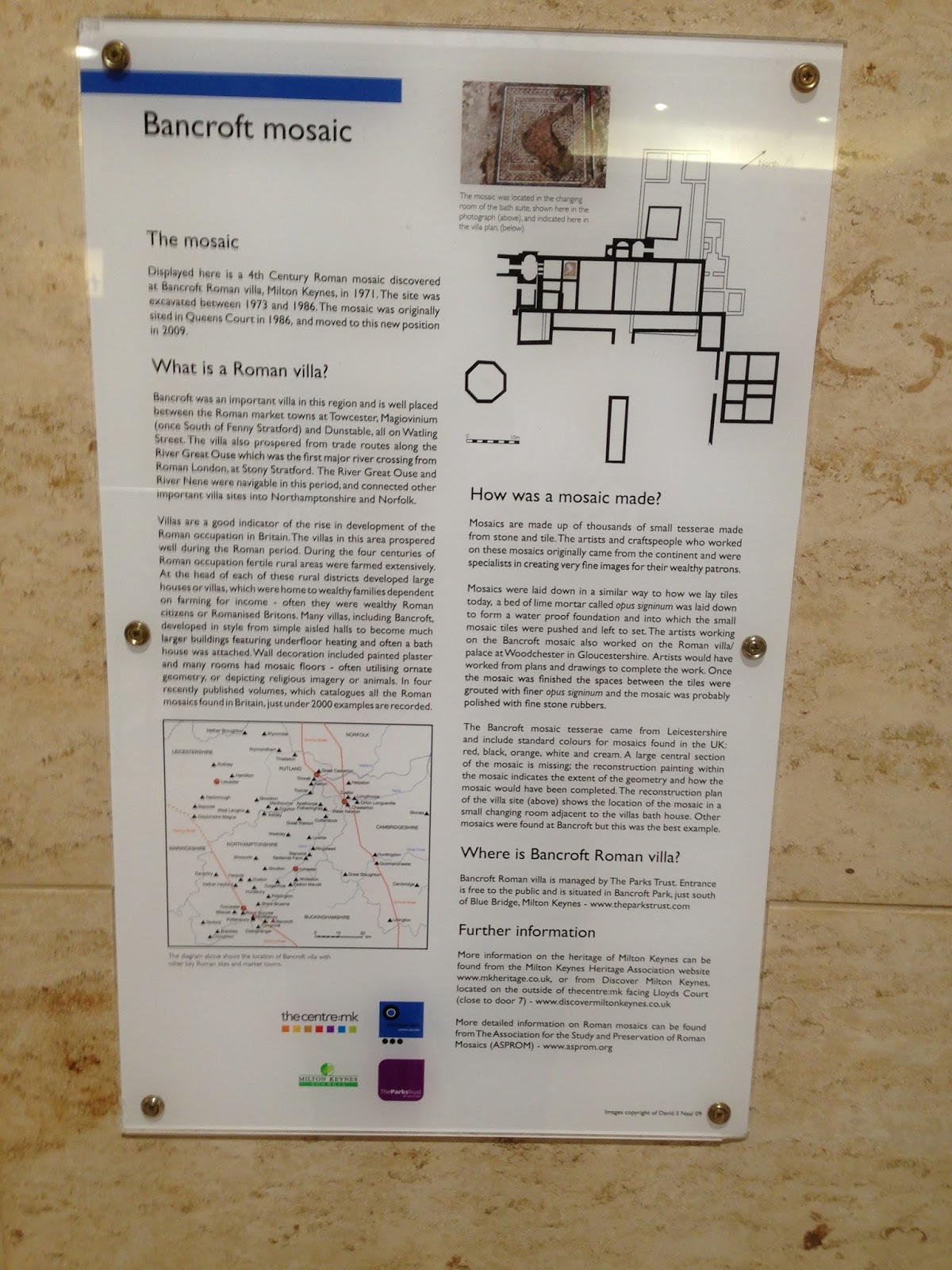


The main residential building was decorated with mosaics. One of these is currently on display in the Milton Keynes shopping area (Centre:mk) - close to the toilets in Deer Walk (Entrance North 9). In front of the villa is a fishpond - and the room layout is explained on the interpretation boards and can be seen on the ground.


Saturday, 11 March 2017

Roman Milton Keynes

Watling Street (though the Romans did not call it this), is the most obvious sign of the Roman presence in Milton Keynes. It enters Milton Keynes at the large island at the south of the A5 trunk route and is still in use through Fenny Stratford; closely passing the Tesco in Bletchley and as 'Denbigh Road,, parallel to Bletcham Way to the start of the V4. This modern road follows the original route (except to avoid Loughton (where the London Road follows Watling Street) and then along the High Street in Stony Stratford.


The Roman villa at Bancroft is also well known, but is not the only villa found in the area. A map in Bob Zeepvat's "Roman Milton Keynes" identifies villas in Holne Chase, Sherwood Drive (both Bletchley), Dovecote Farm in Shenley Brook End, Wymbush, Stantonbury  and Stanton Low. He also  notes that a site in Walton could be a villa and that the Ouse valley "is also particularly well endowed with villas, which occur at intervals of 2-3 kilometres along its north side." The term means farm - and some villas are really a collection of buildings dominated by a place of residence. The book on Bancroft shows that the extent of buildings covered most of the land between the open remains of the villa and the car par and the pétanque pitch. Wymbush's villa included a stone house and outbuildings including a barn. The picture above was taken at the British Museum and is of coins found near Watling Street as it enters Magiovinium (the Roman town mow within Milton Keynes).


Detailed lists of sites and findings are listed in Roman Milton Keynes: Excavations & Fieldwork 1971 - 82 edited by Dennis C Mynard.


An interesting book was published by the Museum of London Archaeology Service called "Becoming Roman". It traces the development from the late iron age to the end of the Roman period at Monkston.


All these publications are available in the Milton Keynes Libraries. The Main library in Silbury Boulevard has an excellent local studies sections sited within the Reference Section (though some can be borrowed).

There's a good interactive resource available at http://www.mkheritage.co.uk/mkm/mkarchaeology/Web%20pages/roman1.html